

Every HVAC owner knows the feeling. You are under a unit, hands full, and your phone buzzes in your pocket. You cannot answer. You tell yourself you will call back in an hour. By the time you do, the customer has already booked someone else.
It feels like a small thing, one call. But if you track it across a month and a year, it is often one of the largest hidden costs in the business. This article walks through the math so you can see what missed calls might be costing your shop, and what to do about it.
Why a Missed Call Is Different From a Missed Email
When a homeowner sends an email, they expect a reply within a day. When they call an HVAC company, they expect an answer now. The caller often has a hot problem: no air conditioning, no heat, water leaking, a strange smell, or a system that stopped mid-cycle.
Callers in that situation do not leave long, polite voicemails and wait. Many hang up and dial the next company. Some will leave a message but are already calling others. The first company to speak with them often wins.
That is why a missed HVAC call is rarely just delayed business. It is frequently lost business.
Doing the Math
You will need a few numbers from your own shop. If you do not know them yet, use rough estimates and refine later.
- How many calls do you miss per month? Check your phone records or ask your office.
- What percentage of callers might have become booked jobs? Use your normal close rate on answered calls.
- What is your average job value? Consider repair, replacement, and maintenance separately.
Here is a simple, conservative example. Suppose you miss 10 calls a month. Say half of them were real service requests, so 5 potential jobs. If you would have booked 3 of those, and your average repair ticket is $500, that is $1,500 per month, or $18,000 per year.
Now suppose one of those missed calls each quarter would have been a $9,000 system replacement. That adds another $36,000 a year.
These are illustrative numbers, not a promise. Your own may be lower or higher. But even a modest version of this math usually surprises owners.
A Smaller Example That Still Matters
You do not need huge numbers for this to matter. If a system recovers only 4 otherwise-missed calls a month, and just 2 turn into $500 repair jobs, that is $1,000 in additional monthly revenue. Over a year, that is $12,000, from calls you were already receiving.
Compare that to the cost of the service that captures them, and the economics can look very favorable. One replacement sale can make the system pay for itself many times over. The exact value depends on your close rate, average ticket, and how many calls you currently miss.
The Hidden Second Cost: Wasted Ad Spend
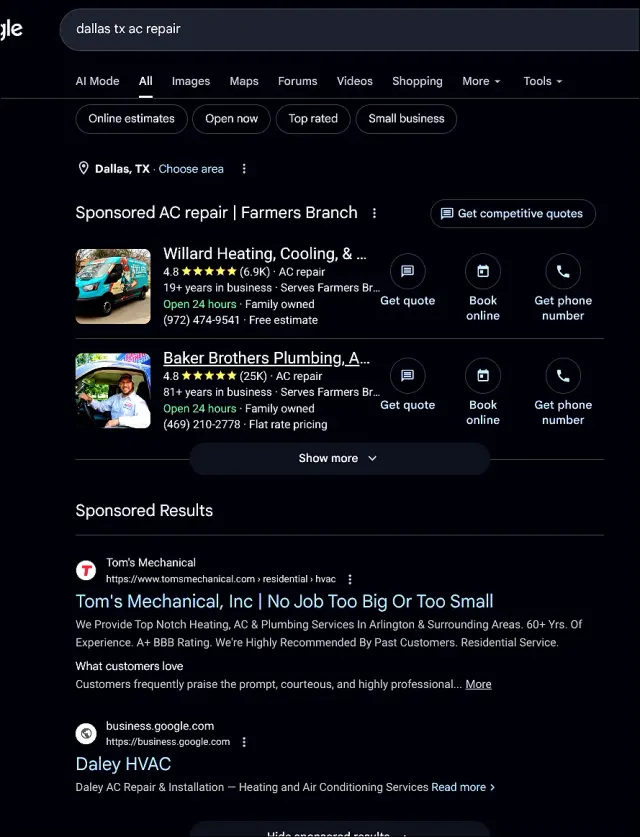
If you advertise, a missed call is even more expensive. You did not just lose the job. You paid to generate that call.
Imagine you spend $2,500 on ads and receive 30 calls, so each call cost about $83 to generate. If 8 of those calls were never answered, you spent roughly $660 on opportunities that went nowhere. Do that every month, and the waste becomes substantial.
This is why we say the biggest financial leak for a small HVAC company is usually not a shortage of leads. It is paying for leads that are unanswered, handled slowly, forgotten, or never followed up. We explore this idea in depth in where HVAC leads get lost.
Before you increase your ad budget, make sure you are capturing the calls you already get. Our guide to managed HVAC PPC advertising emphasizes this: spend should follow a system that answers and tracks every lead.
The Hidden Third Cost: Customer Lifetime Value
A repair customer today can become a maintenance customer next spring and a replacement customer in five years. They may also refer neighbors and leave reviews. Losing the first call means losing everything that follows.
On the other hand, an excellent first experience compounds. That is one reason review automation and follow-up pairs so well with call answering: the people you serve well become the people who recommend you.
When Do Calls Get Missed?
Missed calls cluster in predictable windows.
During jobs. The owner and techs are working, and nobody can pick up. This happens all day, every day.
Evenings and weekends. Emergencies do not keep office hours. Our post on after-hours HVAC calls covers why these calls are often the most valuable and the most likely to go to a competitor.
Peak season rushes. In the first heat wave or cold snap, call volume spikes beyond what any small office can handle.
Lunch, breaks, and sick days. Even a dedicated office person is not available every minute.
While on another call. A second caller gets a busy signal or voicemail.
Why Hiring Isn’t Always the Answer
Many owners respond to missed calls by considering a full-time receptionist. That can be a good move for larger companies, but for a 1 to 4 truck shop, it is a substantial fixed cost with limits. One person cannot cover nights and weekends, will take vacations, and can still be on another call when a second one rings.
Traditional answering services fill some of the gap, but they often work from generic scripts and may not capture the details your dispatcher needs. Callers may feel like they are talking to a stranger who cannot help. We compare the two approaches in more detail in our article on choosing between an answering service and an AI receptionist.
How Gracie Closes the Gap
Gracie, the AI receptionist, answers calls 24/7 or on whatever schedule you choose. She gathers the caller’s name, phone number, address, HVAC problem, and urgency, and can transfer the call or text the owner or technician.
For many small shops, that replaces a good share of the tasks traditionally handled by an after-hours answering service or part-time receptionist. More importantly, it means the caller is talking to something helpful instead of hearing a ring and then a beep.
If a transfer cannot be completed, AI chatbot and SMS follow-up keep the conversation moving, so the prospect gets a quick response and a chance to book an estimate before calling someone else.
Track the Recovery
It is not enough to answer more calls. You need to know what happened to them. Which became booked jobs? Which came from ads versus the map listing? Which still need a follow-up?
LeadTable tracking records leads, call details, outcomes, sources, and follow-up status in one place. You can see how many calls were captured, how many became real jobs, and how much revenue they produced. That turns “I think we are missing calls” into a number you can act on.
A Five-Step Plan to Stop the Leak
- Measure your current misses. Pull a month of call logs and count unanswered and returned-late calls.
- Estimate the cost. Use your own close rate and average ticket.
- Fix the front door. Make sure every call, at any hour, reaches an answer or captured details.
- Add automatic follow-up. Text confirmation and a fast response keep leads warm.
- Track outcomes. Know which leads became jobs, and which fell through.
Ready to Stop Paying for Calls You Never Get?
MicroManaged Media, Inc. built Get Calls AI to help small HVAC contractors capture more of the calls they already pay for and see what turns into booked work. Our system combines managed ads, focused landing pages, Gracie, and LeadTable so a 1 to 4 truck shop can respond with the confidence of a much larger company.
Contact MicroManaged Media today and let us help you calculate what missed calls are costing you.
