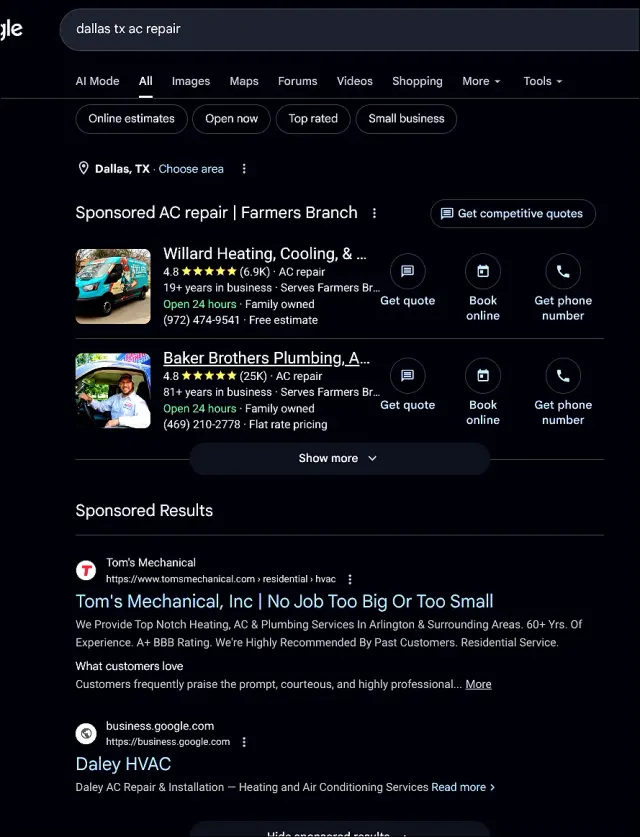



You serve six or seven towns around your shop. Customers call from all of them. But when a homeowner in the next town over searches for “furnace repair near me,” your company does not show up, while a competitor from across the county does. It can feel unfair, since you are closer.
Local visibility depends on many factors, and a smart approach to service area pages is one that many small contractors overlook. Done well, these pages help search engines and homeowners understand where you work. Done poorly, they become thin, repetitive pages that add little value.
This article explains how to approach service area pages in a practical, honest way that fits a small HVAC company.
What Is a Service Area Page?
A service area page is a page on your website dedicated to a specific town, city, or neighborhood you serve. Its job is to tell visitors, and search engines, that you work in that place and to give people there a reason to call you.
For example, a contractor based in one town might have separate pages for several nearby communities, each describing the services available there and why homeowners can trust the company.
These pages are not a trick. They are a way to answer a basic question homeowners have: “Do you work in my area?”
Why They Can Help
Search engines try to show results that match both the topic and the location. If someone searches for AC repair in a specific town, a page that is clearly about that service and that place may be a better match than a generic homepage.
We cannot promise rankings. Results depend on competition, your overall website, your reputation, and many other factors. But a clear, relevant page gives you a chance that a vague one does not.
Service area pages can also help in a very simple way: when homeowners land on a page that mentions their town, they feel more confident you serve them.
The Biggest Mistake: Copy-and-Paste Pages
The most common problem is creating dozens of nearly identical pages with only the town name swapped out. Search engines tend to see through this, and homeowners find it unhelpful. Pages like these may be ignored, or worse, make your whole site look low quality.
If your page for one town could be turned into your page for another town by changing a single word, it probably is not adding enough value.
What Makes a Service Area Page Useful
Aim for pages that offer something real. Here are ideas for content that helps both people and search engines:
- A clear statement of services offered in that area, such as repair, replacement, maintenance, and emergency service
- Real local details, such as the types of homes common in the area, typical system types, or climate considerations, but only if you actually know them
- Your genuine connection to the area, such as how long you have served it or jobs you have done there
- Information about response times, if you can be honest about them
- Reviews from customers in that area, when you have permission to use them
- A clear phone number and simple form
- Photos of your own work, when available
If you do not have enough genuine content for a particular town, it is better to group nearby towns on one page than to create a hollow page for each.
Be Honest About Where You Work
Only create pages for areas you actually serve. Claiming to serve places you do not can frustrate homeowners and create problems if they call and you cannot or will not go. Think about your real service radius, your travel time, and where you can reasonably provide timely service.
If emergency response is not realistic in the farthest towns, you can say that honestly, perhaps by noting that scheduled service is available there while emergency service focuses on closer areas.
Structure Each Page Clearly
A good service area page has a simple structure:
- A headline that mentions the service and the location
- A short introduction explaining what you offer there
- A list of services, each with a brief explanation
- Why homeowners in that area choose you, supported by facts rather than hype
- Reviews or examples from nearby customers, where available
- A clear call to action: phone number and short form
Keep the writing natural. Avoid cramming in the town name repeatedly. One or two natural mentions per section is plenty.
Use Pages That Convert, Not Just Pages That Rank
A service area page that earns a visit but does not produce a call has not done its job. Think about what a homeowner needs when they arrive: confidence that you serve their town, a sense that you are trustworthy, and an easy way to contact you.
A focused HVAC landing page is built to make the phone ring or capture a form lead. The same principles apply to your location pages: clear headline, visible phone number, short form, and no distractions.
Connect Pages to Your Google Business Profile
Your website is only part of local visibility. Your Google Business Profile, your service area settings, and your reviews all work together. Make sure the areas listed on your profile match the places you describe on your website, and that your business name, address, and phone number are consistent everywhere.
Our local search and maps service focuses on strengthening your presence in local results, which is where many homeowners start when they need a contractor nearby.
Reviews Matter in Every Town
Homeowners comparing contractors often look at ratings and recent reviews. A page that mentions your service in a town is more convincing when nearby customers have said good things about you.
If you can, ask satisfied customers in each area to leave a review, and encourage them to mention the type of work you did. Do not write fake reviews, offer payment for reviews, or pressure customers, since those practices can break platform rules and damage your reputation. Our reviews and follow-up service helps you ask happy customers at the right moment and keep reviews coming in.
Do Not Ignore What Happens After the Click
Imagine your service area pages work. A homeowner in a nearby town finds you, calls at 7 p.m., and reaches voicemail. That visibility just produced nothing.
Gracie, the AI receptionist, answers calls 24/7 or on the schedule you choose, gathers the caller’s name, phone number, address, HVAC problem, and urgency, and transfers the call or texts the details to the owner or a technician. Because she collects the address, you can see quickly whether a call comes from a town you want to serve and respond accordingly.
Track Which Areas Bring in Real Work
Over time, you will want to know which towns are producing calls and which ones are producing booked jobs. Perhaps one community sends many calls, but they are far from your shop and hard to schedule efficiently. Another may send fewer but more profitable jobs.
LeadTable tracking records leads, call details, outcomes, sources, and follow-up status in one place, which helps you see the pattern. With that information, you can decide where to expand, where to focus, and where to stop spending effort.
Keep Pages Fresh
Service area pages are not a one-time project. Revisit them periodically to:
- Update reviews and recent examples
- Adjust services as your business changes
- Fix any outdated information
- Add new content as you learn what homeowners ask
A page that was accurate three years ago may no longer reflect your business.
Common Mistakes
- Creating dozens of near-identical pages. Quality beats quantity.
- Claiming areas you do not serve. Be truthful.
- Stuffing keywords. Write for people first.
- Forgetting the call to action. A page without an easy way to contact you wastes traffic.
- Never measuring results. Track calls and booked jobs by area.
- Ignoring reviews. Social proof matters.
A Starter Plan
If you are not sure where to begin, try this:
- List the towns where you genuinely want more work.
- Rank them by how much real information you can offer about each.
- Build useful pages for your top two or three first.
- Add a clear call to action and phone number to each.
- Make sure your Google Business Profile matches your service area.
- Ask for reviews from customers in each town.
- Track calls and jobs by location, then expand based on results.
Ready to Be Found in the Towns You Serve?
MicroManaged Media, Inc. created Get Calls AI to help small HVAC contractors get more qualified calls, miss fewer opportunities, and see which marketing turns into booked work. Local visibility, landing pages, call answering, and tracking are designed to support each other, so the homeowners who find you actually become customers.
Contact MicroManaged Media today and we will talk about where you want to grow, how you appear in local searches now, and what a practical local plan could look like.